
If your business wants to stay visible online in 2026 and beyond, traditional SEO is no longer enough on its own. Search engine optimization still matters, but now it needs to work alongside answer engine optimization, or AEO. Businesses that structure their content for both Google and AI platforms like ChatGPT, Claude, Gemini, and Perplexity are far more likely to be discovered, cited, and recommended.
As more buyers use AI tools to research products, services, and providers, the companies earning visibility are the ones creating structured, credible, easy-to-understand content that AI systems can confidently reference.
At Marketecs, we see this shift happening across industries every day. The good news is that SEO is not disappearing. Strong AEO builds on top of strong SEO foundations.
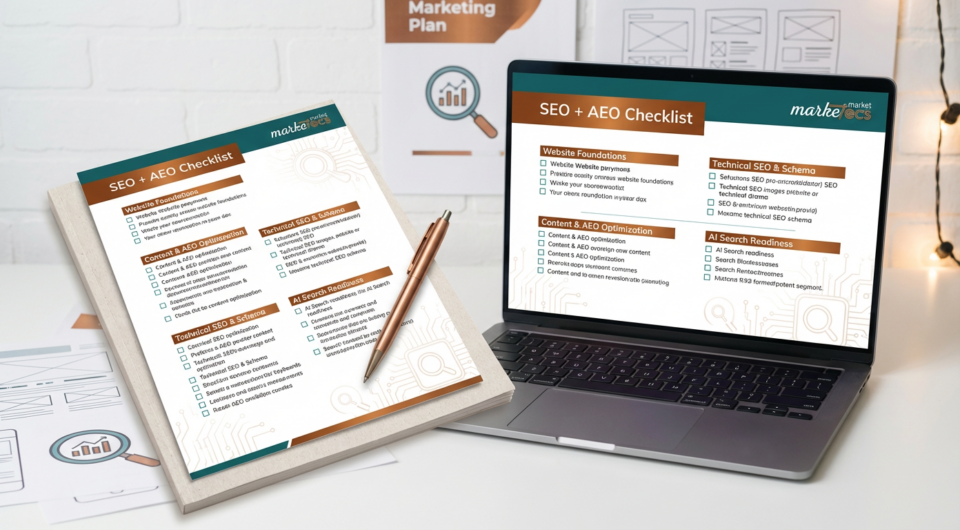
This guide and accompanying video breaks down the practical SEO and AEO best practices businesses should implement now to improve visibility across search engines and AI-driven answer platforms. You’ll also receive access to our SEO and AEO best practices checklist, free!
Video Time Stamps
0:00 Is SEO Really Dead? The Truth About AI Search
0:27 What You’ll Learn Today + Free Checklist
2:16 Know Your Keywords Before You Optimize Anything
3:28 SEO On-Page Structure: Where Keywords Actually Belong
5:43 Content Quality: What Google and AI Both Want to See
7:01 Technical SEO Made Simple: Mobile, Speed & Metadata
8:16 AEO Content Structure: Writing for AI Citations
11:08 FAQs on Every Page: The Highest-Impact AEO Move
11:44 Authority Signals: Why Cross-Platform Content Matters
12:58 Schema Markup Explained (And Why It’s Easier Than You Think)
13:40 WordPress Demo: Yoast SEO Walkthrough in Real Time
19:44 GoHighLevel Demo: AI Fills In Your SEO + Schema in One Click
24:28 5 Mistakes Killing Your Online Visibility (And How to Fix Them)
Links
Grab the free SEO + AEO checklist and start auditing your pages today!
Need Help? Book a free consult.
Check out our YouTube Channel for more tips and tutorials.
Learn more about Marketecs Engine and its capabilities.
What this article covers:
- Why SEO is still relevant and how AEO fits into it
- The exact on-page SEO structure every page needs
- How to write content AI can extract and cite
- How schema markup improves visibility in search and AI
- Simple, no-code ways to implement technical optimization
What Is AEO?
Answer Engine Optimization (AEO) is the process of structuring your website and content so AI systems can easily understand, extract, and cite your information in generated answers.
Unlike traditional SEO, which primarily focuses on ranking webpages in search results, AEO focuses on helping AI platforms confidently quote, summarize, and recommend your content directly inside AI-generated responses.
This includes platforms such as:
- ChatGPT
- Claude
- Gemini
- Perplexity
- Google AI Overviews
AEO does not replace SEO. Instead, it layers on top of proven SEO fundamentals.
SEO vs AEO: What’s the Difference?
SEO:
- Optimizes for search rankings
- Focuses on clicks
- Targets keywords
- Prioritizes webpages
- Relies heavily on backlinks
- Optimizes for Google search
AEO:
- Optimizes for AI citations
- Focuses on answers and visibility
- Targets conversational intent
- Prioritizes extractable content blocks
- Relies heavily on authority and consensus
- Optimizes for AI systems and answer engines
The strongest digital strategy today combines both.
Why SEO Alone Is No Longer Enough
Buyers are changing how they search for information.
Instead of only typing searches into Google, many users now ask direct questions inside AI tools:
- “Who is the best CRM for small businesses?”
- “What is the average cost of SEO services?”
- “How do I improve website conversions?”
- “Best marketing automation platform for consultants”
AI systems pull information from multiple online sources and synthesize responses instantly. If your content is not structured clearly, your business may never appear in those recommendations.
This shift creates two major realities:
- Your website still needs strong SEO foundations.
- Your content now needs to be structured for AI readability and citation.
Businesses that adapt early are creating a significant visibility advantage.
SEO Foundations Still Matter
Before you optimize for AI, your website still needs strong traditional SEO fundamentals.
1. On-Page SEO Structure
Every important page on your site should include:
- One clear H1 heading
- Logical heading hierarchy (H2, H3, H4)
- Keywords naturally integrated into headings and body content
- Internal links to related pages
- Relevant images with descriptive alt text
- Clear calls to action
- At least 500 words of useful content
Search engines and AI systems both rely heavily on page structure to understand context.
2. Strategic Keyword Placement
Keywords still matter, but keyword stuffing does not.
Your primary keyword should appear naturally in:
- The page title
- URL slug
- Opening paragraph
- Select headings
- Meta title and meta description
- Image alt text
- Internal anchor text
The goal is clarity, not repetition.
A helpful question to ask: “Would a human immediately understand what this page is about?”
If the answer is yes, AI systems are more likely to understand it too.
3. Content Quality and Originality
AI-generated generic content is flooding the internet.
That means original insights matter more than ever.
Both Google and AI systems increasingly prioritize:
- First-hand expertise
- Unique perspectives
- Original data
- Practical examples
- Clear explanations
- Real-world experience
If your content simply repeats what already exists online, it becomes difficult for search engines or AI systems to view your site as authoritative.
What Makes Content AEO-Friendly?
AEO-friendly content is designed to be easily extracted, summarized, and cited by AI systems.
That requires a different writing structure than traditional long-form SEO alone.
Put the Answer First
One of the most important AEO principles is “answer first.”
Instead of burying the main point deep inside the article, provide a concise answer near the top of the page.
AI systems prioritize content that quickly answers a question.
For example:
Bad structure: Three paragraphs of background before explaining the solution.
Better structure: Lead with a direct answer, then expand with examples and supporting information.
This is why featured snippets and AI summaries often pull from concise introductory paragraphs.
Create Standalone Content Blocks
AI platforms often extract only a few paragraphs from a page instead of reading the full article in sequence.
That means each section should make sense independently.
A strong AEO paragraph:
- Focuses on one topic
- Provides complete context
- Avoids vague references
- Can stand alone if quoted
This concept is often called “atomic content.”
Use Question-Based Headings
Conversational headings help AI systems understand intent.
Examples:
- What Is Answer Engine Optimization?
- How Does Schema Markup Help AI Visibility?
- Why Are FAQs Important for AEO?
This mirrors how users naturally ask questions inside AI tools.
Add FAQ Sections to Important Pages
FAQs have become one of the most effective AEO structures.
Why? Because AI systems are designed around conversational question-and-answer formats.
Every major service page and blog post should include:
- Real customer questions
- Clear, direct answers
- Full context inside each answer
Well-structured FAQs improve:
- AI citations
- Featured snippets
- People Also Ask visibility
- Long-tail keyword reach
The Growing Importance of Schema Markup
Schema markup helps search engines and AI systems understand the meaning of your content.
Think of schema as structured labels that explain:
- What the page is
- Who wrote it
- What type of content it contains
- What questions it answers
Common schema types include:
- Article
- FAQ
- How To
- Product Organization
- Local Business
Schema has existed for years in SEO, but it has become even more important for AEO because AI systems rely heavily on structured data.
Why Technical Accessibility Matters for AI Search
One overlooked issue in AEO is accessibility for AI crawlers.
Many AI systems cannot fully render JavaScript-heavy pages the way Google can.
This means:
- Important content hidden behind scripts may not be visible
- Pricing tables may not get indexed
- Product information may not be understood
In practical terms, if critical information only loads dynamically, AI tools may miss it entirely. Businesses should ensure important information exists in readable HTML whenever possible.
Authority Signals Matter More Than Ever
AI systems look for consensus across the internet.
That means your authority is not determined by your website alone.
AI platforms evaluate:
- Third-party mentions
- Reviews
- Citations
- Social presence
- YouTube content
- Reddit discussions
- Industry references
- Consistent brand messaging
This is why omnichannel content distribution matters.
The Rise of Reddit and Community Signals
Reddit has become a major data source for AI systems.
Authentic participation in industry discussions can strengthen visibility and brand authority.
However, forced promotion rarely works.
The best approach:
- Contribute useful expertise
- Answer real questions
- Participate consistently
- Build credibility over time
AI systems increasingly value authentic consensus signals.
Original Insights Are Becoming a Competitive Advantage
One of the strongest AEO strategies is creating “net new” information.
AI systems reward unique information because it gives them something valuable to cite.
Examples include:
- Original research
- Internal data
- Case study insights
- Unique frameworks
- Process documentation
- Industry observations
- Expert commentary
This is one reason generic AI-written content struggles to gain long-term authority.
SEO and AEO Checklist for Businesses
Here is a practical starting checklist:
SEO Checklist
- One H1 per page
- Clear heading structure
- Keyword-focused title and meta description
- Mobile-friendly design
- Fast page load speed
- Internal linking
- Image alt text
- Original content
- Clear CTAs
AEO Checklist
- Direct answer near top of page
- Standalone content blocks
- Question-style headings
- FAQ section
- Schema markup
- Conversational formatting
- Original insights
- Cross-platform content distribution
- Consistent brand mentions
For a more detailed implementation guide, download our free SEO + AEO checklist.
FAQ
Is SEO still relevant with AI search?
Yes. SEO provides the structure and signals that AEO builds on.
What is the fastest way to improve AEO?
Add clear summaries, FAQs, and structured formatting to your content.
Do I need to code schema markup?
No. Tools like Yoast and HighLevel can generate it automatically.
How long should blog content be?
At least 500 words, but 800 or more is recommended for better context and visibility.
Final Thoughts
SEO is not dead. What is changing is how people discover information online.
Businesses that structure their content for both search engines and AI systems will have a major visibility advantage over the next several years.
The companies winning in AI search are not abandoning SEO fundamentals. They are strengthening them while also adapting their content for AI readability, extractability, and authority.
The future belongs to businesses that create:
- Clear structure
- Helpful answers
- Original expertise
- Strong technical foundations
- Consistent authority signals across the web
That is where SEO and AEO work together.