
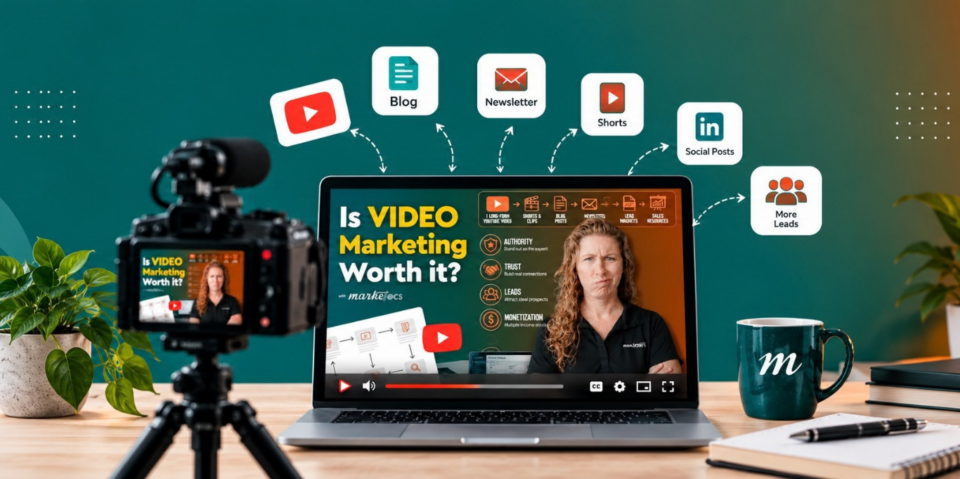
Video marketing can have a high return on investment, particularly for businesses that sell expertise, services, or products that benefit from education and trust. The return may come from leads, sales, authority, client support, and reusable content rather than YouTube ad revenue alone.
I did not start creating weekly YouTube videos because I wanted to become a full-time content creator, I started because I wanted a better way to teach, answer questions, support clients, and create marketing assets I could keep using.
After a full year of weekly publishing, I have a much clearer answer to the question: Is making video content worth it?
For me, yes.
But the reason is more strategic than simply getting views. I break it all down in my video, Is Making Video Content Worth It in 2026? I also created a follow-up video covering the details of my first year, including what I spent, how much time it took, what worked, what did not, and the mistakes I would avoid if I were starting again.
Is Video Content Marketing Worth it?
Video Time Stamps
00:00 Why I Committed to Weekly Video
01:40 Why Video Builds Authority and Trust
02:25 Turning Client Questions Into Video Topics
04:32 Why Video Helps Prospects Know You Before a Call
06:00 What I’ll Cover in My One-Year YouTube Recap
08:35 Why YouTube Matters for Business in 2026
11:53 Video Monetization Beyond YouTube Ad Revenue
13:04 Tracking Video ROI Based on Your Goals
14:11 How One Video Becomes Weeks of Content
16:15 What’s Coming in Year Two
Links
Try HighLevel free for 30 days.
Need help setting workflows up? Book a free consult!
ChatGPT – https://chatgpt.com/
Claude – https://claude.ai/
Descript – https://get.descript.com/tnidj03ncjkd
Canva – https://www.canva.com/
vidIQ – https://vidiq.com/marketecs
Zoom – https://us06web.zoom.us/refer?refCode…
Marketecs Engine – https://www.marketecs.com/marketing-s…
Topics covered
- Whether video marketing is worth the investment in 2026
- What one year of weekly YouTube publishing actually required
- Where the business ROI came from
- How much time and equipment video production took
- How AI and repurposing changed the workflow
- The biggest mistakes I made
- What I would do differently if I were starting today
Is Video Marketing Worth It?
For many businesses, the answer is yes, but the strategy matters.
Video is now a mainstream marketing format. Wyzowl’s 2026 research found that 91% of businesses use video as a marketing tool, while 93% of video marketers consider it an important part of their overall strategy. The same research found that 82% of marketers say video gives them a good return on investment. But those numbers do not mean every business should start publishing weekly YouTube videos.
The better question is: What job do you need video to do?
For a service business, video can help explain complicated ideas, demonstrate expertise, answer common questions, nurture prospects, support sales conversations, and give existing clients resources they can reference later.
That was my motivation.
I started creating weekly videos in May 2025 because I was digging deeper into marketing automation and wanted a way to turn the questions I was getting from clients, prospects, and my own team into reusable resources.
My channel ended up being about 90% marketing automation tutorials, and majority of that was even more focused on the platform that we recommend, High Level. That focus was important because I already knew the subject matter. What I had to learn was how to communicate that expertise effectively through video.
Try HighLevel free for 30 days.
What Does One Year of Weekly YouTube Publishing Actually Take?
I started with what I already had.
That meant the built-in camera and microphone on my computer and Zoom, which I was already comfortable using for business meetings. I had also been using ChatGPT, so I created a custom GPT and project to help with ideation, scripting, SEO, and YouTube best practices.
My first videos were basic. There were no elaborate transitions, animations, or complicated production setups. Most of the videos were screen shares because the goal was teaching, not producing entertainment.
This taught me an important lesson: production quality and content quality are different things. You can improve production over time. It is much harder to manufacture expertise.
Sean Cannell, a well-known YouTube educator and founder of Think Media, puts the principle simply: “Content value matters more than production value.”
I agree.
That does not mean production quality is irrelevant. It means it should support the content rather than become the reason you never publish.
What I Upgraded
I eventually upgraded several parts of my setup, including my microphone, camera, and lighting.
The microphone made the biggest noticeable improvement for me. I expected the camera to matter more, but audio quality had a greater effect on the viewing experience, especially for tutorials where people are listening to me explain something while watching a screen share.
I also moved from recording in Zoom to recording directly in Descript, which simplified my workflow.
The lesson was identify the part of your production that is creating friction, then improve that part, not “buy better equipment.”
How Much Time Does Video Marketing Take?
This is one of the areas where business owners need to be realistic.
My personal time commitment for a weekly tutorial eventually settled at roughly five to eight hours per week, while my video editor also spent approximately that amount of time on the editing side.
My process generally includes:
- Choosing and researching a topic
- Planning the video
- Creating a light outline or script
- Recording
- Reviewing the recording and selecting retakes
- Cleaning up the video
- Sending it to my editor
- Reviewing the finished version
- Creating the title and description
- Publishing or scheduling
- Preparing clips and other content
- Sharing the finished video
Before the editing stage, my own work averaged about three hours for a weekly tutorial. Once I added an editor, the goal was not necessarily to eliminate the time I was spending on it, but to improve the finished product and let someone else handle the more intensive production work.
If you are a business owner, video can easily become a large weekly commitment if you do every part yourself. Before starting, decide which parts you actually want to own.
Where Did the ROI Actually Come From?
This is where my answer changed after a year. My return did not come primarily from YouTube advertising. It came from a stack of business benefits.
I saw increases in leads and opt-ins. People scheduled consultations after sharing that they found me through YouTube. I booked clients and generated affiliate income. I also created videos around specific processes that eventually became products or services.
But there was another benefit that is harder to capture in YouTube Analytics.
The videos became resources I could use throughout the business. When a client asked a question I had already covered, I could send them the video. If a prospect wanted to understand how we approached a particular problem, I could send them a relevant tutorial. When I had a sales conversation about a topic I had already explained, I had something useful to share afterward. That builds authority over time.
Wyzowl’s 2026 research supports the broader business case. 85% of video marketers say video has helped generate leads, while 83% say it has directly increased sales.
The important point is that these are business outcomes, not vanity metrics.
Views are useful, but if your goal is to generate consultations, you should also know:
- How many people clicked through?
- How many booked?
- How did they find you?
- Did they watch a video before contacting you?
- Did the video help move an opportunity forward?
Those metrics tell you much more about whether the investment is working.
Why YouTube Is Especially Useful for Business Content
Video can live almost anywhere, but YouTube has a particular advantage for educational business content because it combines video with search and discovery. A useful tutorial can continue working after the day it is published. That matters when your videos answer evergreen questions.
I have found that a video library becomes increasingly valuable because I can reference it during client conversations, sales calls, and support situations.
YouTube’s Senior Director of Growth and Discovery, Todd Beaupré, has encouraged creators to think about their audience rather than obsessing over “the algorithm.” His advice is particularly relevant for businesses: make content that is genuinely useful to the people you want to reach.
YouTube Creator Liaison Rene Ritchie has made the same point from another angle, explaining that YouTube “does not push videos for creators, YouTube pulls videos for viewers.”
That changes how I think about YouTube strategy. Instead of asking, “What does the algorithm want?”, ask “What does my ideal customer want to watch?”
AI and Repurposing Changed the Economics of Video Marketing
I never wanted video to become another content obligation. I wanted the video to become the source material for the rest of the content system.
That means one long-form video can become:
- A blog post
- A newsletter
- Short-form clips
- YouTube Shorts
- LinkedIn posts
- Social media graphics
- FAQ content
- Sales resources
- Training material
This is one of the biggest reasons I believe video can be worth the investment. If I spend several hours creating one useful video, I want to get more than one asset from that work.
AI has made this process faster. I use AI for ideation, outlines, hooks, titles, descriptions, thumbnail ideas, and repurposing. It can take a transcript and create a first draft of a blog post or identify sections that could become short clips. But I am still making the decisions.
AI helps me move faster. It does not decide what I know, what my audience needs, or what I ultimately want to say. That is also consistent with what I have learned from using multiple AI tools. I may compare several recommendations, combine useful pieces, and then make the final decision myself.
My Biggest Mistakes and Wins from my 1st Year on YouTube
Video Time Stamps:
00:00 Is YouTube Worth It for Business?
01:18 Why I Started Posting Weekly
02:06 My Very Basic Starting Setup
05:00 ROI, Tools, and What I Invested In
07:09 Small Improvements That Made a Difference
10:12 My Weekly Video Process, Team, and AI Workflow
14:26 Was YouTube Worth It?
15:52 Leads, Clients, Affiliate Income, and Sales
17:00 Building the Content Machine From My Own Process
17:38 AI Skills, KAT, and Video Experimentation
18:54 Why Channel Consistency Matters
19:40 How Videos Became Sales and Client Support Assets
20:42 Biggest Mistakes From Year One
22:49 10 Practical Video Tips for Business Owners
29:31 Year Two Plans, AI Satire, Gardening, and Podcast Ideas
32:01 Final Advice for Business Owners
Links
Try HighLevel free for 30 days.
Need help getting started? Book a free consult!
ChatGPT – https://chatgpt.com/
Claude – https://claude.ai/
Descript – https://get.descript.com/tnidj03ncjkd
Canva – https://www.canva.com/
vidIQ – https://vidiq.com/marketecs
Zoom – https://us06web.zoom.us/refer?refCode…
Marketecs Engine – https://www.marketecs.com/marketing-s…
My Biggest Mistakes After One Year of YouTube
The most useful lessons are probably the things I got wrong.
1. I should have watched more YouTube before creating my own videos
I was not much of a video consumer before I became a video creator. That meant I had to learn by doing. If I were starting again, I would spend more time watching the videos my ideal customers already watch.
Look at:
- How quickly they get to the point
- How they structure the opening
- How much editing they use
- Whether they rely on screen sharing
- What their thumbnails communicate
- What keeps you watching
You can learn a lot before you ever press Record.
2. I should have practiced more
I’m busy, so I do not want to record the same video five times, but there were times when another take would have made the video better.
The answer is not perfection. It is knowing when an additional few minutes of preparation will save you from fixing a problem later.
3. My hooks needed more work
The first 30 seconds matter.
I still consider this one of my areas for improvement. A strong topic can lose its audience if the opening takes too long to explain what the video is about.
Get to the problem quickly. Tell people what they will learn. Then deliver it.
4. I should revisit successful topics more often
One of my biggest content challenges is that I tend to put everything I know into one video. That makes it harder to find another angle later. But if a topic matters to your audience, there are probably multiple ways to approach it.
A successful video can lead to:
- A beginner version
- An advanced version
- A case study
- A common mistakes video
- A comparison
- A new update
- A specific use case
Do not assume that covering a topic once means you are finished with it.
What I Would Do If I Were Starting a Business YouTube Channel Today
I would make the process much simpler.
1. Start with customer questions
Your best topics are probably already sitting in your inbox, sales calls, consultations, support requests, and client meetings. If you answer the same question repeatedly, consider turning it into a video.
2. Pick one repeatable format
My channel works because I have a clear format: educational tutorials and screen shares. You do not need a different production concept for every video. A repeatable format makes the process faster.
3. Use the equipment you have
Start with your minimum acceptable setup. When you’re ready to improve it, pay attention to the actual problem. For me, that meant prioritizing audio before spending heavily on other equipment.
4. Build repurposing into the process
Decide before you publish what happens to the video afterward.
If a video requires five to eight hours of your time, identify how you can turn that recording into additional content. That’s where the economics become much more attractive.
5. Measure business results
Track views and watch time, but also track leads, calls, sales, clicks, and the ways existing clients use your content. Ask new prospects how they found you. Look for videos that are repeatedly referenced in conversations. That is where you will start seeing the value that YouTube Analytics alone cannot show you.
So, should your business be making videos in 2026?
After a year of weekly publishing, I still believe the answer is yes for many businesses. But I would not build the strategy around becoming a YouTube influencer. Build it around your expertise. Find the questions your customers are already asking. Create useful answers. Publish them in a format you can maintain. Then turn those videos into additional content and resources.
That is what made video worthwhile for me.
The video itself is one asset. The real value comes from everything that asset can do afterward.
Frequently Asked Questions about Video Marketing
Is video marketing worth it for a small business?
It can be, particularly when customers need education or trust before making a purchase. You do not need a massive audience if your content reaches the right people and helps move them toward a conversation or purchase.
How much time does video content creation take?
In my experience, producing a weekly tutorial takes roughly five to eight hours of my personal time, plus a similar amount of editing time. Your commitment will depend heavily on your format, production standards, and how much you outsource.
Do I need expensive video equipment to start creating video?
No. I started with equipment I already owned and upgraded gradually. I found audio to be one of the most important upgrades, particularly for educational and screen-share content.
How can I get more ROI from each YouTube video?
Build repurposing into your workflow. Turn the video into written content, short clips, email content, social posts, FAQs, and sales resources. The goal is to make the original recording useful in multiple parts of your marketing system.
Should businesses post videos on YouTube every week?
Weekly publishing worked well for my particular strategy, but frequency should be based on what you can sustain. YouTube expert Sean Cannell has emphasized the importance of consistent publishing, while YouTube’s own guidance increasingly focuses on audience satisfaction rather than a rigid publishing schedule.